

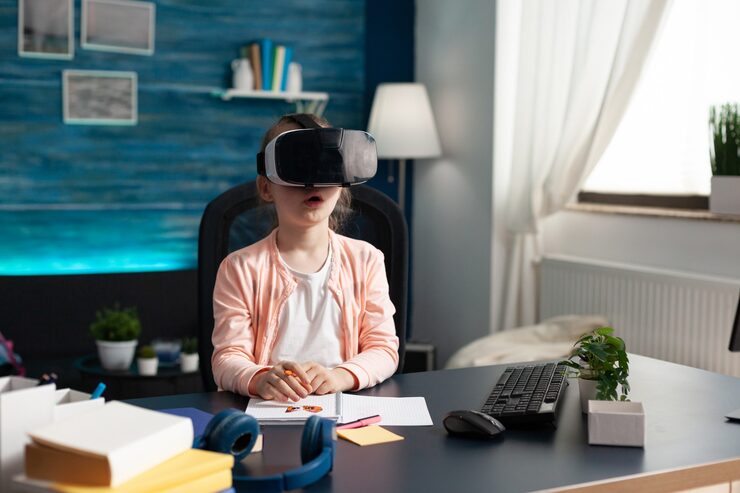
Education Virtual Reality is reshaping how students and teachers experience learning. Gone are the days when education relied solely on textbooks and lectures; immersive technologies now allow students to step into historical events, explore scientific phenomena, and practice skills in realistic environments without leaving the classroom. This transformative approach not only boosts engagement but also enhances understanding, retention, and critical thinking skills.
Immersive Learning Experiences
At the core of Education Virtual Reality is the concept of immersion. Students can virtually visit the Amazon rainforest, explore the surface of Mars, or interact with molecules at the atomic level. These experiences make abstract concepts tangible and foster curiosity, encouraging students to explore subjects more deeply than traditional methods allow.
Consider a biology class where students don VR headsets to dissect a virtual frog. This interactive experience provides hands-on learning without ethical concerns, reducing anxiety and improving comprehension. Similarly, history students can witness historical events unfold in real time, gaining insights that static images or lectures cannot provide.
Enhancing Engagement and Motivation
Student engagement is one of the most significant challenges in modern education. Education Virtual Reality addresses this by creating interactive and gamified learning experiences that capture attention and sustain interest. By making lessons dynamic and visually stimulating, VR encourages active participation, collaboration, and problem-solving.
Educators report that students who learn through VR show higher levels of enthusiasm and motivation. For example, in STEM subjects, VR simulations allow students to experiment with virtual physics labs or engineering prototypes, making complex concepts more approachable and enjoyable.
Personalizing the Learning Journey
One of the key benefits of Education Virtual Reality is its ability to tailor learning experiences to individual needs. Students can progress at their own pace, revisit challenging concepts, and engage in personalized simulations. This flexibility accommodates diverse learning styles and enhances comprehension.
For instance, language learners can immerse themselves in virtual environments where they practice conversations with native speakers, improving fluency and confidence. Similarly, medical students can rehearse surgeries multiple times, gaining practical experience without the pressure of real-world consequences.
Bridging Global Education Gaps
VR technology also has the potential to democratize education. Students from under-resourced schools can access high-quality simulations, virtual field trips, and interactive lessons that were previously limited to privileged institutions. This levels the playing field, ensuring that students worldwide have access to immersive, experiential learning.
Virtual classrooms allow students to collaborate across countries, exchanging ideas, cultures, and perspectives. This fosters global citizenship and cross-cultural understanding, preparing students for a connected, international world.
Teacher Empowerment and Professional Development
Teachers benefit from Education Virtual Reality by gaining innovative tools to enhance lesson plans and engage students. VR can provide insights into student progress through interactive assessments and real-time feedback. Educators can also use VR for professional development, simulating classroom scenarios, testing new teaching strategies, and refining their instructional methods.
Furthermore, VR reduces the logistical limitations of traditional teaching. Complex experiments, field trips, or historical reenactments become feasible within the classroom, saving time, resources, and costs. Teachers can focus on guiding students through meaningful, experiential learning rather than logistical planning.
Integrating VR into the Curriculum
Successfully implementing Education Virtual Reality requires strategic integration into existing curricula. Schools must identify subjects and lessons that benefit most from immersive experiences. STEM subjects, history, geography, and language learning are particularly suitable due to their interactive and exploratory nature.
Infrastructure is also critical. Schools need adequate VR headsets, software, and technical support. Training educators to use these tools effectively ensures that VR is a complement to traditional instruction, rather than a novelty. Partnerships with VR content developers can also provide customized, high-quality learning modules.
Future Trends in Educational VR
The future of Education Virtual Reality is promising. Advancements in haptic feedback, artificial intelligence, and augmented reality will further enhance the realism and interactivity of virtual classrooms. Students may soon collaborate with AI tutors in fully immersive environments or participate in real-time, global virtual labs.
Additionally, VR analytics can provide educators with detailed insights into student engagement, comprehension, and learning patterns. This data-driven approach allows continuous improvement of teaching strategies, ensuring that VR remains a tool for effective, evidence-based education.
Real-Life Success Stories
Several schools and universities have already embraced VR in education with impressive outcomes. Stanford University uses VR to train medical students in complex procedures, reducing errors and improving confidence. High schools in Europe and North America have implemented virtual field trips and history simulations, increasing student engagement and academic performance.
Even small-scale initiatives show promise. Local language learning centers employing VR conversation modules report higher retention rates and accelerated learning compared to conventional methods. These examples demonstrate the scalability and versatility of VR in diverse educational contexts.
Preparing Students for a Digital Future
Integrating Education Virtual Reality into classrooms not only enhances current learning but also equips students with essential digital literacy skills. Familiarity with immersive technologies, problem-solving in virtual environments, and collaborative digital work prepares students for careers in technology, science, healthcare, and global business sectors.
By exposing students to VR early, educators foster adaptability, creativity, and technical proficiency—skills that are increasingly critical in the rapidly evolving workforce.
Read also:
india national cricket team vs england cricket team match scorecard
india women’s national cricket team vs sri lanka women match scorecard
argentina national football team vs bolivia national football team lineups
portugal national football team vs france national football team timeline